
Official overseas process
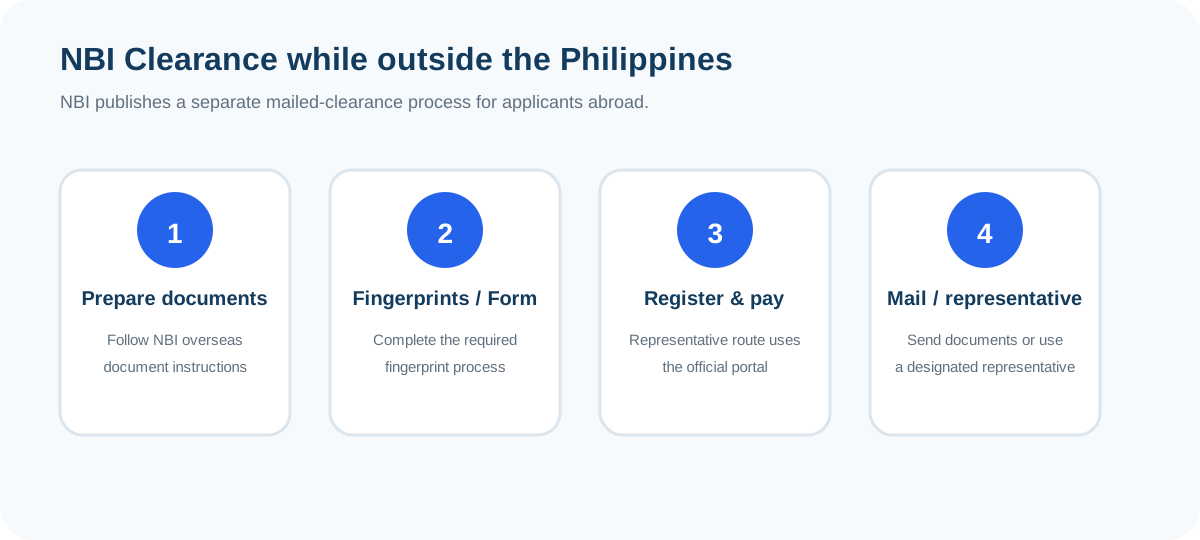
The NBI mailed-clearance page explains procedures for documents prepared abroad and for applications handled by a designated representative in the Philippines.
Who this route is for
This process exists for applicants who are physically outside the Philippines — OFWs, emigrants, students and anyone who cannot appear at an NBI branch in person. If you are currently in the Philippines, even temporarily, the normal local application described in the complete NBI Clearance guide is the route to follow. Do not use the mailed-clearance instructions as a shortcut around appearing when you are actually in the country.
What “mailed clearance” means in practice
“Mailed clearance” describes a document chain rather than a single form. You prepare identity documents and fingerprints where you are, send them — or have them carried — to the Philippines, they are presented at the NBI Mailed Clearance Section, NBI processes them, and the resulting clearance is delivered back to you or collected by your representative. Each handoff takes time, which is why overseas applications need far more lead time than local ones. The processing time guide explains how NBI’s handling window relates to the transit time around it.

Designated representative route
Before going to the NBI Mailed Clearance Section, the representative must register the applicant online at the official NBI portal, choose NBI Main Clearance Center as the preferred site, select a payment channel, secure the reference number and complete payment.
What the representative must do
The representative’s visit follows a fixed sequence: online registration of the applicant at the official portal, selection of NBI Main Clearance Center as the preferred site, choice of a payment channel, securing the reference number, and completion of payment — all before presenting the documents at the Mailed Clearance Section. If any step is skipped, the section cannot accept the application, so walk your representative through the full sequence in advance rather than assuming they know it.
Choosing the right representative
Pick someone reliable and reachable — a family member or trusted friend who can visit the NBI office during working hours, follow instructions precisely and keep your documents safe. This person will handle your identity documents and your payment reference, so the choice matters more than convenience. Confirm they are willing to make a possible second trip if the section asks for anything additional.
What to give your representative
Give clear instructions and only the authority and documents required by the official process: the prepared application documents, the reference number and payment proof, and a clear written authorization describing exactly what they are allowed to do on your behalf. Do not hand over more access or broader authority than the process requires, and keep copies of everything you send them.
Processing and renewal notes
- NBI states a maximum of five working days upon receipt of documents.
- Applications from abroad are processed at the NBI Clearance Building on U.N. Avenue, Ermita, Manila.
- Clearance certificates issued starting 2014 may be renewed through mail or a designated representative using the mailed-clearance procedures.
- Clearances issued before 2014 are treated as new applications for this purpose.
The five-day processing window, explained
NBI states a maximum of five working days upon receipt of documents. The key phrase is “upon receipt” — the clock starts when the Mailed Clearance Section has your complete documents in hand, not when you post them from abroad. International transit, customs handling and any preparation steps on your side all sit outside that window. If you are working toward a deadline, count backwards from it: transit time, plus the five working days, plus a buffer for anything incomplete.
The 2014 date rule
Whether you are renewing or starting over depends on when your existing clearance was issued. Clearance certificates issued starting 2014 may be renewed through mail or a designated representative using the mailed-clearance procedures. Clearances issued before 2014 are treated as new applications for this process. Check the issue date on your old clearance before you decide which set of requirements to prepare — the full comparison is in the next section, and the renewal guide covers renewal rules in general.
New application abroad vs renewal abroad
These are not identical. A new overseas application follows the mailed-clearance requirements for identity documents and fingerprints. A renewal can use the mailed or designated-representative procedure only when the existing clearance meets the NBI’s date rule.
Clearances issued before 2014
The NBI mailed-clearance page says they are treated as new applications for this process rather than renewals.
Clearances issued starting 2014
They may be renewed by mail or designated representative using the published mailed-clearance procedures.
| New application abroad | Renewal abroad | |
|---|---|---|
| Who it is for | First-time applicants, or holders of pre-2014 clearances | Holders of clearances issued starting 2014 |
| Document basis | Full mailed-clearance requirements: identity documents and fingerprints | Mailed or designated-representative procedure under the date rule |
| Representative option | Available under the mailed-clearance procedure | Available under the mailed-clearance procedure |
| Processing point | NBI Clearance Building, U.N. Avenue, Ermita, Manila | NBI Clearance Building, U.N. Avenue, Ermita, Manila |
After you receive the clearance abroad
NBI instructs recipients to examine the certificate for the embossed NBI dry seal and affix the right thumbmark in the space provided. Follow the latest official instructions included with your processed certificate.
Check the dry seal and thumbmark
Before anything else, examine the certificate for the embossed NBI dry seal — its presence is part of what makes the document genuine — and affix your right thumbmark in the space provided, exactly as the included instructions describe. A clearance presented without the required thumbmark, or one whose seal looks wrong, can be questioned by the receiving organization. If anything about the document looks off, contact official NBI channels before using it.
Keep copies of everything
Photograph or scan the issued clearance, your application documents and every receipt while they are all in one place. If the original is lost in transit later, or an employer asks for a copy while the original is being authenticated, having clear digital copies saves you from starting over. Store them somewhere you can reach from abroad.
Plan the overseas application as a document chain
An application from abroad involves identity and fingerprint preparation, delivery to the Philippines, processing at the designated NBI office and return delivery or representative collection. The NBI’s handling time does not include every international transit and preparation step, so allow time for each handoff.
| Stage | What to verify |
|---|---|
| Before fingerprints | Use current NBI instructions and ask the relevant Philippine embassy or consular post about local document procedures. |
| Before sending | Check names, signatures, photographs, fingerprint impressions and supporting identification. |
| Representative | Give clear instructions and only the authority and documents required by the official process. |
| NBI processing | The stated handling period begins when complete documents are received; transit is separate. |
| Return delivery | Use tracking where practical and retain copies of what was sent. |
Confirm the receiving organization’s rules
The organization requesting the clearance decides how recent it must be and whether authentication, translation or legalization is also required. Check those rules before starting so mailing time does not leave you with a document that is unsuitable for its intended use.
Authentication and translation may be separate requirements
Some employers, immigration authorities and licensing bodies require steps beyond the clearance itself — such as authentication, apostille, or translation into another language. These are requirements of the receiving organization, not of NBI, and each adds its own processing time. Confirm the complete list of what your recipient needs before you mail anything, so a “finished” clearance does not turn out to be only half the requirement. For the document side of a local application, the requirements guide and the valid IDs guide are useful references.
Common mistakes in overseas applications
Overseas applications fail most often for preventable reasons. Avoid these five:
- Sending incomplete documents. NBI’s handling time starts only when complete documents are received. A missing signature or unreadable fingerprint impression restarts your wait.
- Ignoring the 2014 date rule. Preparing a renewal packet for a pre-2014 clearance wastes weeks — those are treated as new applications.
- Counting only NBI’s five days. Transit in both directions plus preparation time usually exceeds the processing window itself. Plan the whole chain, not just the middle.
- Vague instructions to the representative. “Go to NBI and process this” is not a briefing. Give the written checklist described above.
- Skipping the recipient’s rules. A clearance that arrives too late, or without a required authentication step, fails its purpose no matter how correctly it was processed.
Applying from abroad FAQs
Where are overseas applications processed?
NBI says all clearance applications coming from abroad are processed at the NBI Clearance Building on United Nations Avenue, Ermita, Manila.
How long does mailed clearance take?
NBI states a maximum processing time of five working days upon receipt of documents. Mailing/transit time is separate.
Can a representative handle the Philippine side?
Yes. NBI publishes a designated-representative procedure with online registration, payment and presentation of documents at the Mailed Clearance Section.
Can I apply from abroad if I never had an NBI Clearance?
Yes. A new overseas application follows the mailed-clearance requirements for identity documents and fingerprints.
My clearance was issued before 2014. Can I renew it by mail?
No. The NBI mailed-clearance page says clearances issued before 2014 are treated as new applications for this process rather than renewals.
How do I pay for an overseas application?
The designated-representative procedure includes online registration, payment channel selection and payment. Confirm the current options on the official NBI portal.
What if my mailed documents are incomplete?
NBI’s handling time begins when complete documents are received, so check names, signatures, photographs, fingerprint impressions and supporting identification before sending.
Does the five-day processing include delivery time?
No. NBI states a maximum of five working days upon receipt of documents. Mailing and transit time is separate.
What should I do when the clearance arrives?
NBI instructs recipients to examine the certificate for the embossed NBI dry seal and affix the right thumbmark in the space provided, following the latest official instructions.
Can I use the eGovPH eClearance renewal from abroad instead?
Some applicants check the eGovPH eClearance renewal option. Confirm whether it covers your situation on official NBI channels before relying on it.