
Current standard fee

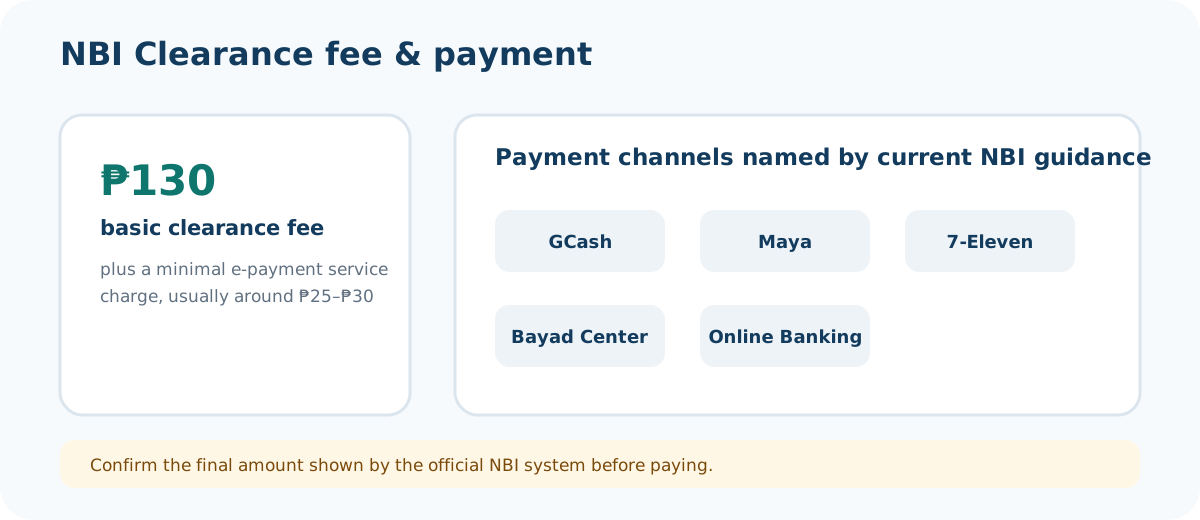
For a standard application, the official NBI How to Apply page lists a ₱130 basic clearance fee. It says a minimal e-payment service charge is added and is usually around ₱25–₱30.
That two-part structure is the key to reading any NBI fee figure correctly. The ₱130 is the government service amount for the clearance itself; the extra charge belongs to the electronic payment channel you choose. When someone quotes a single total like ₱155 or ₱160, they are usually adding the typical service charge to the basic fee — but your own checkout may differ slightly depending on the channel.
How the fee is structured
NBI Clearance pricing has two layers. Understanding which layer you are looking at prevents most of the confusion people report about the fee.
The ₱130 basic clearance fee
This is the amount the NBI itself publishes for the clearance service in its current how-to guidance. It covers the standard application — the record check and issuance of the clearance. It does not include anything a bank, e-wallet, or payment counter adds on top.
The e-payment service charge
Because applications and payments run online, the payment channel adds its own service charge. Current NBI guidance describes this as minimal and usually around ₱25–₱30. The charge goes to the payment processor, not to the NBI, and it varies by channel — which is why two applicants can legitimately pay slightly different totals for the same clearance.
Payment channels and service charges
After you complete the online application form, the official portal generates a reference number and shows the payment channels available for your transaction. You choose one, pay the amount shown, and keep the proof of payment. The NBI payment guide walks through this flow in more detail.
Channel availability can change, so treat the options inside your live transaction as the current list. As a general orientation, applicants commonly see these categories:
| Channel category | How it usually works | What to watch |
|---|---|---|
| E-wallets (for example, GCash) | Pay inside the wallet app using the reference number from your NBI transaction. | The wallet shows the service charge before you confirm — read it, don’t skip it. See the guide to paying NBI Clearance via GCash. |
| Over-the-counter partners | Present the reference number at a partner outlet and pay in person. | Keep the machine-printed receipt; a handwritten note is not proof of payment. |
| Bank and online-banking channels | Pay through a bank’s bills-payment facility using the reference details. | Service charges vary by bank; posting can take longer than e-wallets. |
Keep your proof of payment
Save the receipt and the reference number until your clearance is claimed or your record is fully resolved. If the payment does not reflect on your transaction, that receipt is the document you will need — see the payment-not-reflected troubleshooting guide before paying a second time.
Why old fee figures still appear online
An older NBI Citizen’s Charter page still displays legacy figures such as ₱115, ₱165 and ₱415 without the same current explanation. The live transaction generated by the official NBI Clearance system should be treated as the final amount for your application.
Old figures survive in three places: outdated official documents that were never taken down, old news articles and blog posts, and screenshots shared in chat groups and social media. None of these update themselves when the process changes. This site’s editorial policy is to label legacy figures as historical rather than presenting them as current — that is why you will see conflict disclosures instead of a single “official-looking” number copied from an old page.
First-Time Job Seekers
The dedicated FTJS process is free of charge for qualified applicants who meet the program requirements.
“Qualified” matters here: the free benefit applies when you go through the First-Time Job Seeker program and meet its conditions — not automatically to every young applicant. The NBI directs FTJS applicants to a dedicated portal rather than the normal registration flow, so starting in the wrong place can cost you the benefit. Read the First-Time Job Seeker guide before you register.
Typical total vs official base fee
The standard base fee is the government-service amount. The final amount you pay can be higher because the selected electronic payment channel adds a service charge. That is why many users see a total near ₱155 even though the NBI page describes the basic clearance fee as ₱130.
Do not treat a typical total as a permanent fixed fee. The live official transaction is the best place to confirm the exact amount for your chosen channel. If a friend paid ₱155 last year and your checkout shows ₱160, neither of you is wrong — the channel and its current service charge explain the difference.
What about renewal fees?
Renewal generally follows the same published fee structure as a standard application: the basic fee plus the payment channel’s service charge. The guidance reviewed does not publish a separate, different renewal price.
That includes renewal through the eGovPH eClearance route — the launch announcement describes the service, not a special fee. Whatever route you take, confirm the exact amount inside your live transaction. The full NBI Clearance renewal guide covers eligibility and the renewal steps.
Understand the amount at checkout
Separate the clearance charge from the payment channel’s service fee. Current NBI guidance identifies a ₱130 basic fee and says a minimal e-payment service charge, usually around ₱25–₱30, is added. Review the final amount generated by the live official transaction before paying; this website does not calculate or collect an applicant’s bill.
| Amount or claim | How to treat it |
|---|---|
| ₱130 basic fee | Published in the current NBI how-to guide before the service charge. |
| About ₱25–₱30 extra | The usual range stated for e-payment service charges; the live channel shows the total. |
| Legacy totals on older pages | Historical information, not a substitute for the current checkout amount. |
| “Guaranteed processing” surcharge | Avoid unofficial sellers and payments to personal wallets. |
When to stop before paying
Pause if the domain is not an official NBI service, the reference does not match, the recipient is a private individual, or the amount differs without explanation. Checking these details is safer than trying to recover a misdirected payment.
Red flags at the payment step
- The site address is not an official NBI domain — check the URL character by character.
- You are asked to send money to a personal e-wallet number or bank account.
- Someone promises a “guaranteed” clearance, faster HIT clearing, or no-appearance processing for an extra fee.
- The amount on screen does not match the reference in your transaction and no one can explain why.
- You are pressured to pay immediately or lose your slot.
If anything feels off, stop, keep your reference number, and verify through the official portal or the NBI appointment flow rather than through whoever is pressuring you.
Fee FAQs
Why does the NBI site show ₱130 but my payment is higher?
The current NBI guidance says a minimal e-payment service charge, usually around ₱25–₱30, is added to the ₱130 basic fee.
Is First-Time Job Seeker NBI Clearance free?
The official FTJS Citizen’s Charter lists the process as free of charge for qualified applicants using that program.
Which fee should I trust if pages disagree?
Use the amount generated by your live official NBI transaction and payment channel. Older official documents can remain online after a process changes.
How much does NBI Clearance renewal cost?
The published guidance reviewed describes the standard ₱130 basic fee plus the usual e-payment service charge, and renewal generally follows the same structure. Confirm the exact amount in your live transaction before paying.
Can I pay the NBI Clearance fee in cash at the branch?
The current normal flow centers on completing the online application and paying through the channels shown in your transaction before visiting. Do not hand cash to fixers or unofficial collectors.
Why is my total different from what someone else paid?
Different payment channels add different service charges, and published figures change over time. The live checkout for your own transaction is the reliable comparison, not another person’s receipt.
Do I have to pay again if my application gets a HIT?
A HIT means your record needs further verification; the guidance reviewed does not describe an automatic second fee for the same transaction. Never pay a second amount to an unofficial person.
What should I do if my payment is not reflected?
Keep your receipt and reference number, allow the channel’s normal posting time, and check your transaction status before paying again. See the payment-not-reflected troubleshooting guide for the steps.
Is there a refund if I change my mind after paying?
The official material reviewed does not document a general refund policy for paid NBI transactions. Treat a completed payment as final for that transaction and confirm details before paying.