
FTJS requirements
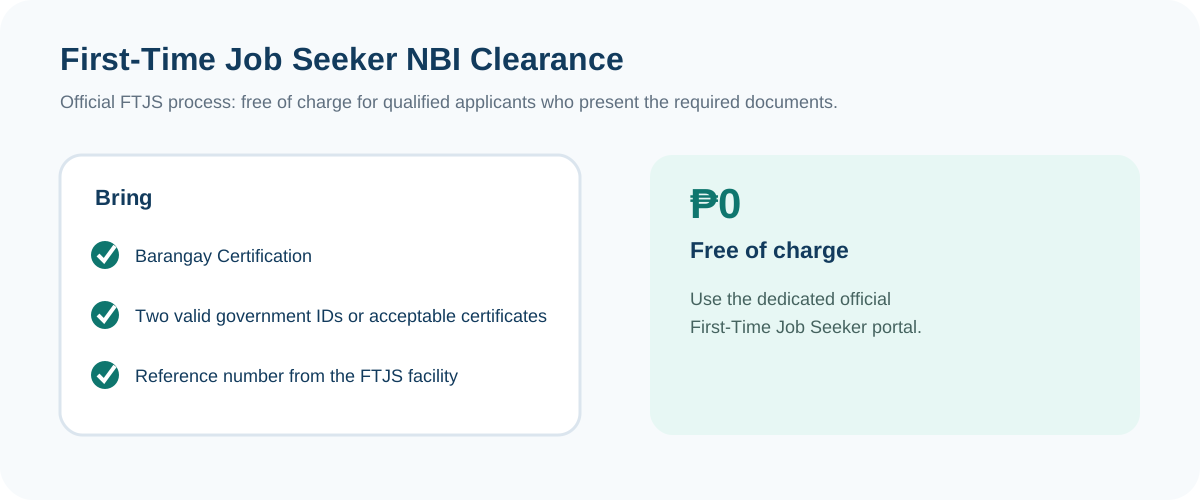
The NBI FTJS Citizen’s Charter lists a Barangay Certification on official letterhead, dry-sealed and signed by the Punong Barangay or an authorized barangay officer, plus two valid government-issued IDs or acceptable certificates.
The Barangay Certification in detail
This is the document that proves your first-time job seeker status, so it gets the closest scrutiny. The charter is specific about its form: it must be on official barangay letterhead, dry-sealed, and signed by the Punong Barangay or an authorized barangay officer. A plain printout, a photocopy without a dry seal, or a certification signed by someone without authority can be rejected at the branch. Request it early, read it before you leave the barangay hall, and have any error — a misspelled name, a wrong date — corrected on the spot rather than discovering it at the NBI counter.
Identity documents: what counts
In addition to the certification, the charter requires two valid government-issued IDs or acceptable certificates. Bring originals, and check that the names and birth details on all your documents agree with each other and with what you entered online. If you are unsure which IDs are accepted, review the complete list of valid IDs for NBI Clearance before your visit. Mismatched details are one of the most common reasons an otherwise qualified FTJS application gets delayed.

Fee
The official FTJS process lists None (Free of Charge) in the fee column for the program’s steps.
What “free of charge” covers
The charter’s fee column refers to the NBI processing steps themselves — the program does not charge the standard clearance fee to qualified applicants. It does not cover your personal costs of getting there: transportation to the barangay hall and the NBI branch, photocopies, or any fees the barangay itself may charge for issuing the certification. Budget for those separately so the “free” process does not stall for lack of fare money.
HIT and Quality Control still apply
FTJS status does not bypass NBI record verification. The Citizen’s Charter says that a No HIT application proceeds to printing, while WITH HIT applicants return on the scheduled date; a For Quality Control case proceeds to interview and verification.
The three paths after biometrics
| Path | What happens | What you do |
|---|---|---|
| No HIT | Record check finds no match requiring review. | Proceed to printing and claiming as instructed. |
| WITH HIT | A possible match needs manual verification. | Return on the scheduled date with the branch’s instructions. |
| For Quality Control | The case needs interview and verification at the Quality Control Section. | Follow the Quality Control direction with supporting identity documents. |
Being free of charge changes nothing about verification. If you want to understand the review process in depth, read the NBI HIT guide — every path in the table above is explained there step by step.
How the FTJS route differs from a normal application
The difference is not only the fee. The program has its own documentary requirement, dedicated portal/facility and processing lane. That is why a qualified first-time job seeker should start with the FTJS instructions instead of paying a standard transaction and trying to change it later.
Barangay Certification
The official Citizen’s Charter says the certification should be on official barangay letterhead, dry sealed and signed by the Punong Barangay or an authorized barangay officer.
Identity documents
The charter requires two valid government-issued IDs or acceptable certificates in addition to the certification.
The dedicated FTJS portal
NBI maintains a separate First-Time Job Seeker facility — the official portal at firsttimejobseekers.nbi.gov.ph — rather than routing FTJS applicants through the standard clearance portal flow. Use that facility from the start: it generates the correct reference for the FTJS lane, and starting in the standard portal is how applicants end up paying for a transaction they then cannot convert.
Why you should not pay first and ask later
A common and expensive mistake is completing a standard paid application and then asking the branch to reclassify it as FTJS. The program is a separate process with its own documentary requirement and lane, not a discount code applied after the fact. If you already paid for a standard transaction, check official NBI guidance before assuming anything about refunds or reclassification — and next time, start at the FTJS facility.
Step-by-step FTJS application plan
- Confirm the correct route. The first-time job seeker benefit is a special process, not a discount code for a standard application.
- Secure the Barangay Certification. The NBI charter describes an official-letterhead certification, dry sealed and signed by the Punong Barangay or an authorized officer.
- Prepare two acceptable identity documents. Bring originals and check that names and birth details agree.
- Use the dedicated FTJS facility. Save the generated reference number before going to the branch.
- Complete biometrics and verification. The branch captures the photograph, fingerprints and signature before record checking.
FTJS eligibility and document checklist
| Check | What the charter requires |
|---|---|
| First-time job seeker status | The program is for first-time job seekers; confirm eligibility through the official FTJS portal. |
| Barangay Certification | Official barangay letterhead, dry-sealed, signed by the Punong Barangay or an authorized officer. |
| Identity documents | Two valid government-issued IDs or acceptable certificates, with consistent names and birth details. |
| Correct facility | Apply through the dedicated FTJS facility and keep the generated reference number. |
Run through this checklist the night before your branch visit. Every item you verify at home is one less reason to be sent back for a second trip. For the branch visit itself — what to wear, what to bring, how early to arrive — the appointment guide and the NBI branches guide fill in the practical details.
What happens after biometrics?
The official charter separates applicants into No HIT, WITH HIT and Quality Control paths. A No HIT result can proceed to printing. A HIT receives a return schedule, while Quality Control may require an interview and further verification. The short agency processing figures in the charter do not include every queue or delay, so they should not be treated as a guaranteed total visit time.
No HIT: straight to printing
If the record check finds nothing requiring review, your application proceeds to printing and you claim the clearance as instructed. This is the fastest path — another reason to make sure your documents are complete and consistent before biometrics, since document problems are the main avoidable cause of delay at this stage.
WITH HIT: return on the scheduled date
A possible record match means reviewers need time to verify whether the record belongs to you. The branch gives you a return schedule — commonly around 5 to 10 working days, though your branch’s exact date controls. Keep the slip, bring the requested documents when you return, and do not pay anyone who promises to “clear” the HIT for you.
Quality Control: interview and verification
Some HIT cases are routed to the Quality Control Section for interview and verification. If the branch directs you there, follow that instruction, bring supporting identity documents, and answer questions directly. It is an official verification step, not an accusation.
Common FTJS mistakes to avoid
Most failed FTJS applications fail for preventable reasons. Watch for these five:
- Starting in the standard lane. Paying for a normal application and then asking for FTJS treatment wastes money and time. Begin at the dedicated FTJS facility.
- A defective Barangay Certification. Missing dry seal, wrong signatory, or errors in your name or date. Read the certification at the barangay hall and fix problems there.
- Mismatched IDs. Names or birth dates that disagree across documents trigger questions at best and rejection at worst. Align everything before you go.
- Losing the reference number. The FTJS facility generates a reference for your application — screenshot it, write it down, and keep it with your documents.
- Assuming “free” means “no verification.” HIT and Quality Control apply to FTJS applicants exactly as they do to everyone else. A namesake match does not care about your fee status.
If anything else goes wrong — a scheduling conflict, a document question, a confusing instruction at the branch — the Help Center covers troubleshooting across the whole NBI process.
FTJS FAQs
How much is NBI Clearance for a qualified first-time job seeker?
The official FTJS Citizen’s Charter lists the process as free of charge.
Can an FTJS applicant still get a HIT?
Yes. The charter includes No HIT, WITH HIT and Quality Control processing paths.
Where should I apply?
Use the official First-Time Job Seeker facility linked by NBI.
Who qualifies as a first-time job seeker?
The program is for first-time job seekers. Confirm your eligibility through the official FTJS portal and the NBI Citizen’s Charter before applying.
What if my Barangay Certification has an error?
Have it corrected or reissued by the barangay. The charter requires the certification on official letterhead, dry-sealed and signed by the Punong Barangay or an authorized officer.
I already paid for a standard NBI application before. Can I still use the FTJS route?
The benefit is designed for first-time job seekers. If you already completed a standard paid application, check official NBI guidance before assuming you qualify.
Is the FTJS clearance different from a regular clearance?
The clearance document itself is the same. The difference is the dedicated process: its own documentary requirement, dedicated portal and facility, and no processing fee.
What happens if I get a HIT as an FTJS applicant?
The same charter paths apply: a No HIT result proceeds to printing, a WITH HIT case returns on the scheduled date, and a Quality Control case goes through interview and verification.
Where is the official FTJS portal?
Use the official First-Time Job Seeker facility at firsttimejobseekers.nbi.gov.ph, linked by NBI.
Do I still need to book an appointment for the FTJS route?
The FTJS facility generates a reference number for your application. Follow the facility and branch instructions for scheduling your visit.