
What “HIT” means
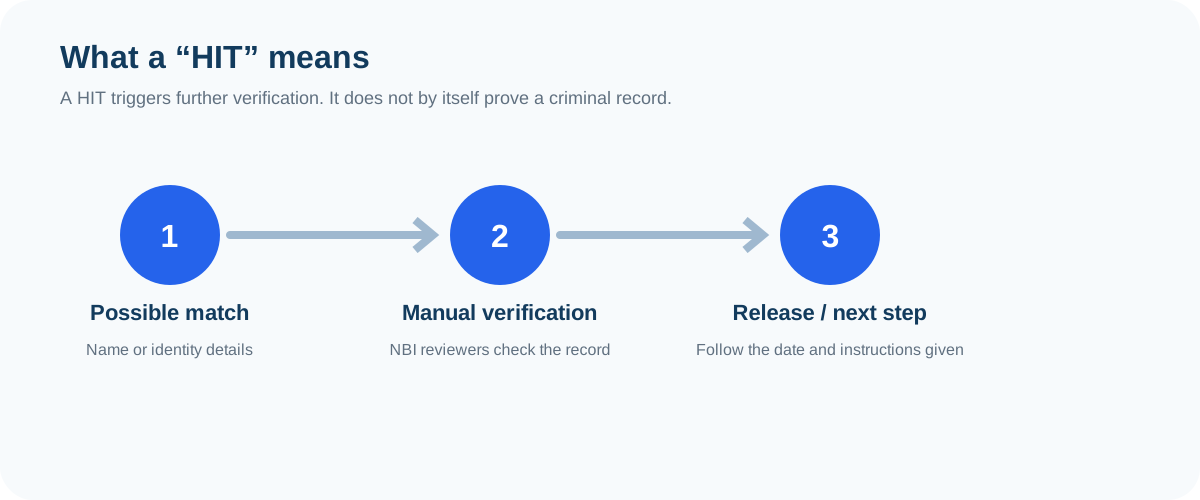
The current NBI how-to page explains that a HIT can occur when your name is similar or identical to a person who has a pending case or record. NBI then needs panel reviewers to manually verify whether the record belongs to you.
A verification status, not a verdict
The single most important thing to understand is that a HIT is a pause for checking, not a finding against you. The system flagged a possible match; human reviewers must now confirm whether that match is actually you. Until that verification is done, the clearance is simply not released. Nothing about a HIT, by itself, says anything about your character, your history or the outcome of the review.
How the match happens
When your application is processed, your name and personal details are checked against NBI records. If those details resemble a record in the database — same name, similar name, or matching secondary details — the system marks the application for manual review rather than releasing it automatically. This is a deliberate safety mechanism: it is better for a namesake to wait a few days than for a record to be attached to the wrong person. If you want the full application context first, start with the complete NBI Clearance application guide.
How long does a HIT take?
The current NBI how-to page says applicants are usually asked to return after a specified period, commonly 5 to 10 working days. Treat the exact date printed or given by your branch as the controlling instruction.
Why the 5–10 day window is not a promise
The commonly cited 5–10 working days is a usual return period, not a guaranteed release date. It describes how long the initial manual verification typically takes, but your case may resolve sooner or need more time depending on what the reviewers find and how busy the branch is. Plan around the date your branch actually gives you, not the general figure quoted online.
What can make verification take longer
A straightforward namesake check usually follows the standard window. Cases that need more time include referrals to the Quality Control Section for interview and verification, situations where the branch asks you to produce a specific document such as a court clearance, and periods when the branch is handling high volumes. If your return date has passed without release, contact the same branch through current official channels before making another trip — do not simply assume the worst. For context on normal timelines without a HIT, see the NBI Clearance processing time guide.
What about Quality Control?
The First-Time Job Seeker Citizen’s Charter explicitly describes a “For Quality Control” path where applicants with HIT may proceed to the Quality Control Section for interview and verification. If the branch directs you to Quality Control, follow that instruction rather than trying to solve the HIT through a third party.
What the Quality Control interview involves
Quality Control is a deeper verification step for certain HIT cases. The charter describes it as an interview and verification path at the Quality Control Section. Expect to answer questions confirming your identity and personal details, and to present the supporting documents the section asks for. It is an official part of the process — being referred there is not an accusation.
How to prepare for Quality Control
Bring every identity document you have, especially the valid IDs accepted for NBI Clearance, plus the slip and reference number from your application. If the branch mentioned a specific record or asked for a particular document, obtain exactly what was requested before your visit. Answer questions directly and consistently; the interview exists to distinguish you from the matched record, and clear, consistent answers help the reviewers do that.
Why a namesake can trigger an NBI HIT
The NBI is checking identity against records, and names are not unique identifiers. People can share the same first name, middle name and surname, or have very similar personal details. A HIT gives the NBI time to confirm whether the matched record belongs to you.
This is why a HIT should be treated as a verification status rather than a legal conclusion. Do not tell an employer or family member that the system “found you guilty” simply because the clearance is under HIT review.
Common names match more often
Applicants with very common Filipino name combinations tend to encounter HITs more frequently, simply because more records share similar names. But a HIT can happen to anyone — even an unusual name can resemble a record closely enough to trigger manual review. There is nothing you can do in advance to prevent it, and having complete, consistent requirements and documents is the best preparation regardless.
What a HIT does not mean for your record
A HIT creates no entry on your personal record and is not shared as a finding with anyone. It is an internal processing status. The only practical effect is that your clearance is held until reviewers confirm the match is not you. Once verification is complete and the record is confirmed as belonging to someone else, the application proceeds normally.
What to do after the branch tells you to return
- Keep the slip, transaction details or instructions given by the branch.
- Return on the date stated by NBI staff.
- If the branch requests a court clearance or another document because of a specific matched record, obtain the exact document they requested.
- If directed to Quality Control, follow that interview/verification path.
The correct response depends on what the NBI reviewer found. A generic online article cannot replace branch-specific instructions after a real record match.
Documents to bring when you return
At minimum, bring the slip or written instruction the branch gave you, your valid IDs, and your reference number or receipt. If the branch named a specific document — for example a court clearance tied to a particular matched record — obtain exactly that document; a substitute will only cause another round trip. Keep copies or photographs of everything you submit, in case anything needs to be re-verified.
Record the branch instruction before leaving
Write down the exact return date, branch or section, any document requested and whether the instruction is for ordinary releasing or Quality Control. Keep the receipt and reference number. A photograph or written copy of the instruction is more useful than remembering only “come back next week.”
| Situation | Appropriate response |
|---|---|
| Ordinary HIT review | Wait for the assigned date and return to the stated releasing point with the required documents. |
| Quality Control | Follow the interview or verification direction and bring supporting identity documents requested. |
| Return date has passed | Contact the same branch through current official channels before making another trip. |
| Someone offers paid removal | Do not pay an unofficial person; a HIT is resolved through NBI verification. |
A HIT is not a verdict and should not be described as proof of a criminal record. The accurate explanation is that a possible record match needs human verification before release.
HIT statuses you may encounter
| Status | What it means | Your next step |
|---|---|---|
| HIT / under review | A possible record match needs manual verification by reviewers. | Wait for the assigned return date and come back as instructed. |
| For Quality Control | Your case needs the interview and verification path at the Quality Control Section. | Follow the Quality Control direction and bring supporting identity documents. |
| Cleared for release | Verification is complete and the application can proceed. | Claim the clearance at the stated releasing point with your slip and IDs. |
HIT and your employment or travel plans
A HIT often arrives at the worst possible moment — right when an employer is waiting for your clearance. The practical move is to manage the timeline, not the verdict. Tell the requesting party that the application is under standard NBI verification and share the return date on your slip, without describing the HIT as a finding against you.
Talking to your employer
Most HR departments in the Philippines have seen HITs before; it is a routine status. A short, factual update works best: your application is undergoing NBI verification and you have a return date. Offer to provide the clearance as soon as it is released, and ask whether they can hold the requirement open until then. Do not resign from a current job or make irreversible plans around the original release date.
Build buffer time into deadlines
If you are applying for work abroad or a time-sensitive opportunity, start the NBI process as early as possible precisely because a HIT can add working days. The NBI branches guide can help you plan the visit itself, and the Help Center covers related troubleshooting if other issues come up alongside the HIT.
NBI HIT FAQs
Does HIT mean I have a criminal record?
No. It means a possible match requires further verification. A namesake or similar identity can trigger the review.
How long does a HIT take?
The current NBI how-to page says the usual return period is around 5–10 working days, but the branch’s exact return date is what you should follow.
Do I pay again after a HIT?
The current NBI how-to guidance says the applicant returns to claim the clearance after review without paying extra for the HIT review itself.
What is Quality Control?
The NBI FTJS Citizen’s Charter describes a Quality Control Section interview/verification path for certain HIT cases.
Can I still get my clearance after a HIT?
Yes. A HIT is a verification status, not a denial. Return on the date stated by the branch with the slip and any documents they requested.
What documents should I bring when I return after a HIT?
Bring the slip or instructions the branch gave you, your valid IDs, and any specific document the branch requested, such as a court clearance for a particular matched record.
Can I follow up on a HIT without going back to the branch?
If your return date has passed, contact the same branch through current official channels before making another trip.
I got a HIT on a renewal. Is that normal?
A HIT can occur on any application because the matching is name-based. Follow the same return process the branch gives you.
Someone offered to clear my HIT for a fee. Is that legitimate?
No. Do not pay a fixer or private person who promises to remove a HIT. A HIT is resolved through NBI verification only.
How will I know my HIT is cleared?
The branch releases the clearance after verification is complete. Follow the return date on your slip and keep your receipt and reference number.