
NBI Clearance Requirements 2026 — Quick Checklist
This checklist is for the standard local online application route. First-Time Job Seekers and applicants abroad should follow their separate requirements below.
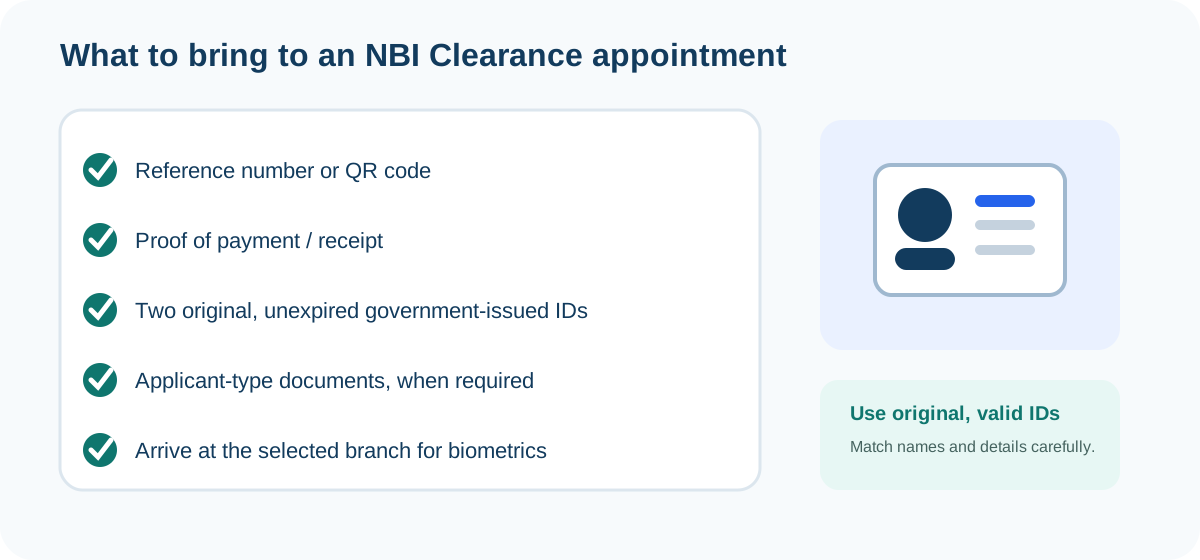
- Reference number or QR code from the online transaction.
- Proof of payment or receipt.
- Two original, unexpired government-issued IDs.
- Any extra document specifically requested by NBI for your case.
Before travelling, use the guide to finding and verifying an NBI Clearance branch, then confirm your selected office through the official locator.

Requirements by applicant type at a glance
Use this table to find your route first, then read the matching section below for the details. Mixing checklists from different routes is one of the most common reasons applicants bring the wrong documents.
| Applicant type | Core documents | Notes |
|---|---|---|
| Standard local applicant | Reference number or QR code, payment proof, two original unexpired government IDs | Online route through the official portal, then a branch visit |
| First-Time Job Seeker | Barangay Certification (dry-sealed and signed) plus two valid IDs or acceptable certificates | Dedicated FTJS facility and program-specific process |
| Renewal (eligible) | Previous clearance details and transaction reference | Online or eGovPH routes for qualifying post-2014 clearances with unchanged details |
| Applicant abroad | Documents per the NBI mailed-clearance instructions | Separate fingerprint and mailing process; do not use the local checklist |
Once you know your route, book your NBI appointment and read what to bring to your appointment the night before you travel.
Which IDs count as valid?
Current NBI guidance for the standard process asks for two original, unexpired government-issued IDs. Three words in that rule do most of the work, so here is what each one means in practice.
Original, not photocopied
Photocopies, phone photos of an ID and scanned printouts do not satisfy the requirement. Bring the physical ID cards or documents themselves. If an ID is lost or damaged, replace it before your appointment rather than hoping a copy will be accepted.
Unexpired
Check the expiry date on both IDs before you travel. An expired ID is one of the simplest — and most common — reasons a branch visit fails. If either ID expires close to your appointment date, renew it first or bring a different valid ID.
Government-issued
Company IDs, school IDs without government backing and similar private documents do not count as government-issued IDs. The full valid IDs guide lists the accepted government IDs and explains edge cases such as recently expired documents and name mismatches.
Documents to prepare before you register
Some requirements matter before you ever click “Apply for Clearance.” Getting these ready first makes the online registration faster and avoids profile errors that are annoying to fix later.
An active email address and mobile number
Account registration uses an OTP, and account recovery can depend on the same contact details. Use an email and mobile number you will still control months from now — not a borrowed SIM or an inbox you rarely open. If you change numbers later, update your account rather than creating a duplicate.
Your exact personal details as they appear on your IDs
Have your IDs in front of you when you fill in the Applicant Information Form: full legal name, date of birth, place of birth and civil status. The branch verifies your identity against the information you entered online, so copying from the IDs beats typing from memory.
Your applicant route, decided in advance
Decide before registering whether you are a standard applicant, a First-Time Job Seeker or an overseas applicant. Each route has its own process, and starting on the wrong one wastes time. The complete application guide walks through the standard route step by step.
First-Time Job Seeker requirements
The official FTJS Citizen’s Charter lists a Barangay Certification on official barangay letterhead, dry-sealed and signed by the Punong Barangay or authorized officer, plus two valid government-issued IDs or acceptable certificates.
Getting the Barangay Certification right
The certification is the document FTJS applicants most often get wrong. It must be on official barangay letterhead, carry the dry seal and be signed by the Punong Barangay or an authorized officer. A plain printout or an unsigned certification can be rejected, so confirm the format with your barangay hall before you go.
Use the dedicated FTJS process
The FTJS program is not the normal application with a discount code — it uses a dedicated official facility and program-specific steps. Read the First-Time Job Seeker guide from the start instead of beginning a standard application and trying to convert it later.
Applicants abroad
Applicants outside the Philippines use the mailed-clearance instructions, which have a different document and fingerprint process. Do not copy a standard branch checklist and assume it applies overseas.
What makes the overseas route different
The mailed-clearance process involves fingerprinting (typically arranged where you are) and mailing documents to the NBI, rather than walking into a branch with two IDs. Because the steps and forms differ, a local checklist will leave you missing required items. Read applying for NBI Clearance from abroad for the full overseas process.
Renewal from abroad
Overseas applicants renewing an existing clearance should check whether their certificate qualifies for the mailed renewal route. The NBI Clearance renewal guide explains the post-2014 eligibility rule for renewals by mail or representative.
Requirement mistakes to avoid
- Bringing expired IDs.
- Using a different spelling of your name in the portal and on your ID.
- Following the standard route when you actually qualify for the FTJS facility.
- Using an outdated third-party checklist instead of current NBI instructions.
The expired-ID trap
Applicants often check that they have two IDs without checking the expiry dates. Make it a habit: the moment you book the appointment, pull out both IDs and read the dates. Replacing an ID takes time, and discovering the problem at the branch counter means a wasted trip.
The name-mismatch problem
Married names, missing middle names and hyphenation differences between the portal profile and the physical ID are a steady source of branch delays. If your IDs themselves disagree with each other, sort that out with the issuing agencies first — the NBI branch cannot fix another agency’s document.
Why NBI Clearance requirements should be separated by applicant type
A common problem on third-party guides is combining standard, first-time job seeker and overseas requirements into one list. That can cause applicants to bring the wrong documents. Our checklist keeps each route separate because the official NBI sources do the same.
Standard local application
The standard route centers on the online reference number, payment proof and two original, unexpired government-issued IDs. These support the identity information already entered in your online profile.
First-Time Job Seeker
The FTJS program adds the Barangay Certification requirement and uses a dedicated official facility. It is not simply the normal application with a discount code.
Applying from abroad
Overseas processing can involve Form No. 5, fingerprinting and mailed or representative procedures. Those requirements should not be mixed into a local appointment checklist.
How to avoid requirement problems at the branch
- Bring original, unexpired IDs.
- Make sure the legal name in your portal profile matches the IDs you present.
- Keep your transaction reference and payment proof accessible.
- Read the dedicated FTJS or overseas guide if you are using one of those routes.
- If NBI asks for an additional document because of a discrepancy or HIT, follow that branch instruction instead of a generic checklist.
Do a bag check the night before
Lay out everything the evening before: both IDs, the reference number or QR code (saved on your phone and ideally printed), and payment proof. Applicants who pack in the morning are the ones who discover a missing ID halfway to the branch.
When the branch asks for something extra
Sometimes a branch requests an additional document because of a profile discrepancy or a HIT review. That instruction overrides any online checklist, including this one. Bring what the branch asks for and keep a copy for your records.
Requirements FAQs
What are the basic NBI Clearance requirements?
For the standard local route: a reference number or QR code from your online transaction, proof of payment, and two original, unexpired government-issued IDs. Other applicant types have additional documents.
How many valid IDs do I need for NBI Clearance?
Current NBI guidance for the standard branch process asks for two original, unexpired government-issued IDs.
Are photocopies enough instead of original IDs?
Current NBI guidance says the IDs should be original and not expired.
What if I only have one valid ID?
Current NBI guidance for the standard process asks for two IDs. If you only have one, check the latest official guidance or contact NBI before your visit rather than assuming a single ID will be accepted.
Do I need a printed application form?
The most important transaction identifier is the reference number or QR code. Bringing a saved or printed copy of your transaction details can still be useful. Follow the current branch instructions.
Do First-Time Job Seekers use the same documents?
No. They also need the official Barangay Certification and must use the program-specific process.
Do applicants abroad use the same checklist?
No. NBI publishes separate mailed-clearance instructions for overseas applications.
What if the name on my ID differs from my online profile?
Fix the mismatch before your branch visit. The branch verifies your identity against the information you entered online, and spelling differences can delay processing.
Do I need the same documents when renewing?
It depends on the renewal route. Eligible online and eGovPH renewals are built around your existing clearance record, while a branch-based renewal follows the standard document checks. Check the renewal guide for your route.