
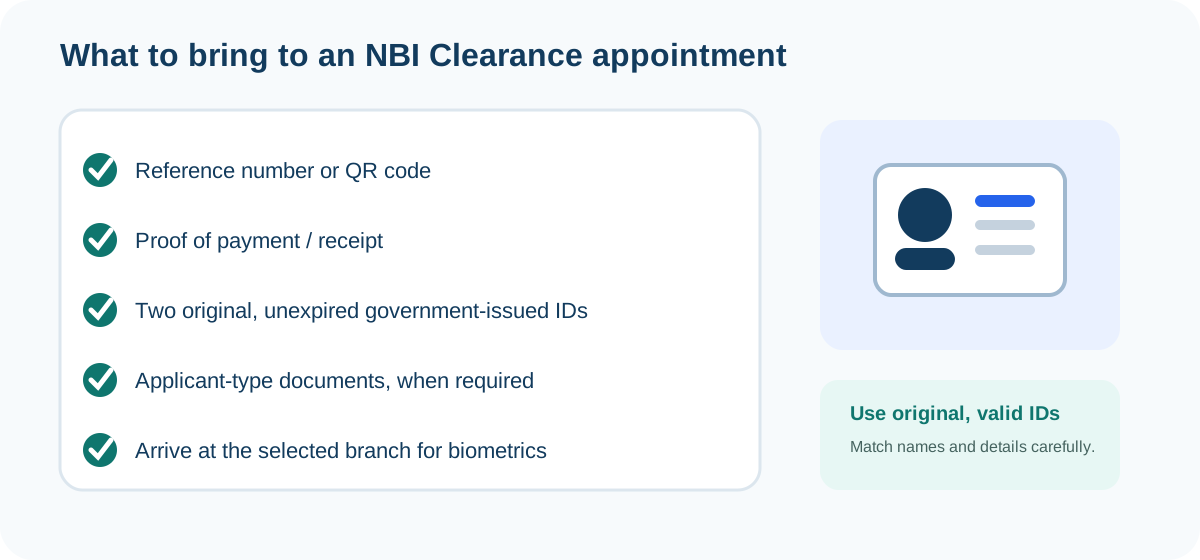
Standard appointment checklist

Once you have booked your slot through the NBI appointment flow, packing is straightforward. The branch needs to connect three things — the transaction you created online, the payment you made, and the identity you are presenting — so every item below serves one of those three purposes.
- Printed or digital reference number / QR code.
- Proof of payment or receipt.
- Two original, unexpired government-issued IDs.
- Any additional document requested by NBI for your situation.
Special routes
First-Time Job Seekers should bring the Barangay Certification and required IDs/certificates. Applicants abroad should follow the mailed-clearance instructions rather than this local branch checklist.
Using the wrong checklist is a common source of wasted trips. A first-time job seeker who packs only the standard items may be sent home for the missing Barangay Certification, while an overseas applicant who follows the local list will be preparing for a branch visit that is not part of their process at all.
How to confirm which route is yours
Your route is determined by your situation: standard paid applicants use the checklist on this page; first-time job seekers follow the FTJS program list; applicants outside the Philippines follow the mailed-clearance process. When in doubt, match your situation to the official program names — “First-Time Job Seeker” and “mailed clearance” — rather than guessing from a generic packing list.
First-Time Job Seekers
The FTJS route adds the Barangay Certification to the standard items, plus the program’s required IDs or acceptable certificates. Because the FTJS checklist differs from the standard one, pack from the program list — not from memory of a regular application. The First-Time Job Seeker guide has the full program checklist.
Applicants applying from abroad
If you are outside the Philippines, do not use this local branch checklist. The overseas process runs through mailed clearance with its own documentary requirements and submission steps. Follow the applying for NBI Clearance from abroad guide and the official mailed-clearance instructions instead.
Dress guidance
The current NBI how-to page recommends avoiding sandos, tank tops, shorts and slippers for the official photo and suggests smart casual or a collared shirt. The guidance is short and easy to follow — it exists because the branch captures your official photo during the visit.
Why the dress guidance exists
The branch takes your official photo during processing, and the photo becomes part of your clearance record. Dressing to the guidance avoids a preventable problem on the day: you do not want a two-minute clothing issue to delay an appointment you booked weeks in advance.
What to wear in practice
A collared shirt or neat smart-casual top is the safest choice. Avoid sandos, tank tops, shorts and slippers as the current guide recommends. When in doubt, dress slightly more formally than you think necessary — it costs nothing and removes one variable from the visit.
Keep the appointment checklist simple
The branch needs to connect three things: the transaction you created, the payment you made and the identity you are presenting. That is why the reference number, receipt and valid IDs are the core standard items.
Reference number
Keep a digital screenshot and, if convenient, a printed copy. The goal is to make the transaction easy to retrieve at the branch. Save the reference in more than one place — a screenshot in your gallery plus the confirmation email, for example — so a dead phone battery or a deleted message does not leave you empty-handed.
Proof of payment
Bring the receipt or proof of payment for the exact reference number of this transaction. A receipt for a different or mistyped reference may not validate your application, so check that the numbers match before you leave. If anything about the payment looks wrong, read the NBI Clearance payment guide before your appointment day.
IDs
Bring two originals that are not expired. If your records recently changed, carry the relevant supporting document if NBI has instructed you to do so. For help choosing which two to carry, see the valid IDs for NBI Clearance guide.
Special-route documents
FTJS applicants need the Barangay Certification; applicants abroad should follow the overseas process rather than this local checklist. If the NBI asked you for an additional document for your specific situation, that document outranks any general checklist — bring it.
Final check before leaving home
Run through this table at the door. Thirty seconds of checking beats a wasted trip across the city. Most failed visits are not about eligibility — they are about one forgotten item.
| Check | Why it matters |
|---|---|
| Reference number or QR code opens clearly | The branch must identify the transaction; keep a screenshot as backup. |
| Payment matches the reference | A receipt for another or mistyped reference may not validate this transaction. |
| Two original, unexpired IDs | Current standard-process guidance calls for two government-issued IDs. |
| Name and birth details agree | Differences may need supporting documents or official clarification. |
| Office and route are confirmed | Branch availability and operating conditions can change. Confirm your branch on the NBI Clearance branch locator before traveling. |
Protect your documents
Do not give an unofficial helper your password, OTP, complete reference number or control of your NBI account. This independent website does not need copies of your IDs. First-Time Job Seekers and overseas applicants should use their route-specific checklists because the standard appointment list does not cover every additional document.
Fixers and unofficial helpers
No unofficial helper needs your NBI account password, OTP codes or full control of your transaction. Anyone who asks for these is not helping you — they are taking over your application. If someone offers to “speed up” your appointment for a fee, walk away and use the official channels.
Keep copies secure
Keep a secure backup of your reference number and receipt — for example in a password-protected note or a private cloud folder — but do not leave copies of your IDs or clearance in shared chats, public posts or on someone else’s phone. If you run into a problem you cannot solve, the troubleshooting steps in our Help Center are a safer next step than handing documents to a stranger.
After the appointment: keep your proof
The checklist does not end at the branch door. Keep your reference number and payment receipt until the clearance is claimed and, if needed, verified — if any follow-up is required, the branch will ask for the transaction details first. Store them the same secure way you stored them before the visit, and do not discard the receipt the moment you leave the counter.
If there is a gap between your appointment and claiming the document, the processing time guide explains what to expect while you wait.
Mistakes that delay branch processing
These are the preventable errors that most often turn a short branch visit into a return trip:
- Relying on a single screenshot. Phones die, galleries get cleaned and messages get deleted. NBI says a printed or digital reference can be brought — “saving it in more than one form can be useful” is the official hint. Keep two copies.
- Bringing the wrong receipt. Double-check that the payment proof matches the reference number of the transaction you are claiming. A receipt for another reference may not validate.
- Ignoring the dress guidance. It takes no effort to wear a collared shirt, and it removes one possible delay at the photo step.
- Bringing photocopies instead of originals. Current guidance calls for original IDs — a photocopy or a phone photo of an ID is not a safe substitute. See the valid IDs guide for the originals rule.
- Skipping the name-and-details check. If the name or birth details on your IDs do not agree with each other or with your NBI profile, sort it out before the appointment instead of discovering it at the counter.
Appointment checklist FAQs
Should I bring proof of payment?
Yes. Current NBI guidance includes proof of payment/receipt among the branch items.
Should I print the reference number?
NBI says a printed or digital reference number/QR code can be brought. Saving it in more than one form can be useful.
What should I wear?
NBI’s current guide recommends avoiding sandos, tank tops, shorts and slippers and suggests smart casual or a collared shirt.
Can I show my reference number on my phone?
Yes. NBI says a printed or digital reference number/QR code can be brought. Keep it readable on screen and save a backup copy in case your phone has problems.
What if my payment does not show up?
Check the transaction in your payment channel and confirm the reference number matches your application. See the NBI Clearance payment guide for next steps.
Do First-Time Job Seekers need anything extra?
Yes. Bring the Barangay Certification plus the required IDs or certificates for the program. See the First-Time Job Seeker guide.
What if I forget an item at home?
You may need to return with the missing document. Run through the final checklist above before leaving, and check the appointment guide if you need to reschedule.